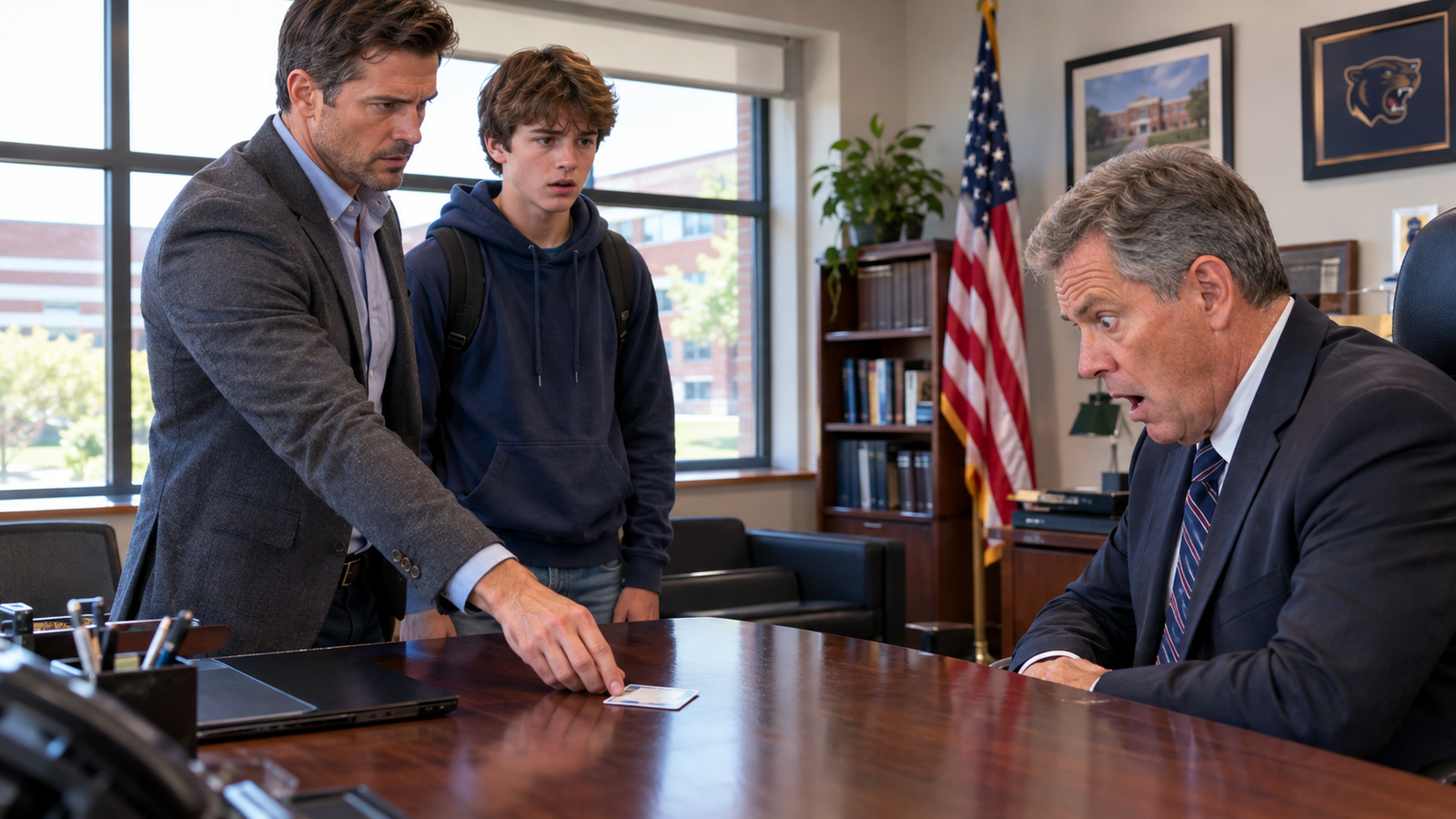
The Principal Said, “This School Is Mine—You Can’t Tell Me What to Do”… Then the Father Revealed His Identity
It was supposed to be a simple meeting between a father and a school principal.
Instead, it became a moment nobody inside that office would forget.
The morning had started like any other school day in a quiet American community. Students were moving through the hallways, teachers were preparing for classes, and parents were dropping their children off before heading to work.
But one father had decided that he needed answers.
His teenage son had come home the previous afternoon looking unusually quiet. When his father asked what had happened, the boy initially said nothing.
Eventually, he explained that there had been a problem at school.
According to the boy, a decision had been made about him without giving him a proper opportunity to explain his side of the story.
His father listened carefully.
He didn’t immediately become angry.
He didn’t threaten anyone.
Instead, he told his son, “If something happened, we will find out the truth. But we will do it the right way.”
The next morning, the father drove his son to school.
Rather than dropping him off and leaving, he walked with him toward the administrative office.
The school secretary looked up as they entered.
“Good morning. How can I help you?”
“I’d like to speak with the principal,” the father said.
The secretary checked the principal’s schedule.
“He can see you for a few minutes.”
The father thanked her.
A few moments later, the office door opened.
“Come in.”
The father and his son entered.
The principal sat behind a large desk covered with folders and paperwork. He looked at the boy and then at his father.
“What seems to be the problem?”
The father calmly explained why he had come.
He wasn’t demanding special treatment.
He wasn’t asking the school to ignore its rules.
He simply wanted to understand why his son had been treated the way he had.
The principal leaned back in his chair.
“I’ve already handled the situation.”
The father nodded.
“I understand. I’d just like to hear exactly what happened.”
The principal sighed.
“Look, Mr. Davis, school administrators have to make difficult decisions every day. We can’t have parents coming into the office questioning everything we do.”
The father remained calm.
“I understand that. But I’m not questioning everything. I’m asking about my son.”
The principal’s tone became noticeably harsher.
“I think you need to understand something.”
The father waited.
“This is my school,” the principal said.
The room suddenly became quiet.
The principal continued.
“I decide what happens here. You don’t come into my office and tell me how to run it.”
The father looked at him for several seconds.
His son stood silently beside him.
There was no anger on the father’s face.
Only disappointment.
“I never said that I wanted to run your school,” he replied.
“Then we’re finished here,” the principal said.
The father didn’t move.
“I’d like to ask one more question.”
The principal looked irritated.
“What?”
“Are you certain you want to end this conversation without checking the information I brought with me?”
The principal frowned.
“What information?”
The father reached into his jacket.
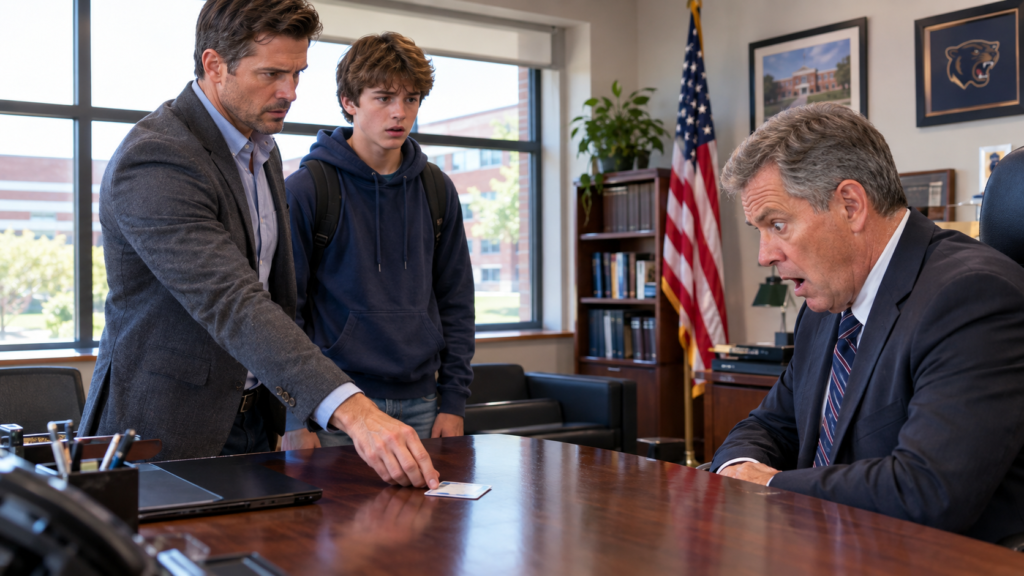
He removed a small identification card and placed it carefully on the principal’s desk.
The principal barely glanced at it.
Then he stopped.
His eyes moved across the card again.
His expression changed.
He picked it up.
He read it a second time.
Then a third.
The confidence that had filled the room only moments earlier suddenly disappeared.
The principal looked at the father.
“You’re…”
The father nodded.
The principal slowly stood from his chair.
For several seconds, nobody spoke.
The teenage boy looked at his father, confused.
“Dad, what’s going on?”
His father turned toward him.
“I wanted you to see something important,” he said.
“What’s that?”
“That you should never judge someone by how much power you think they have.”
The principal was still holding the identification card.
The person he had dismissed as an ordinary parent was not an ordinary visitor.
He was connected to the organization responsible for overseeing the school’s administration and had a level of authority the principal had clearly not expected.
Suddenly, the principal’s words from minutes earlier sounded very different.
“This is my school.”
The father looked at him.
“No,” he said calmly. “It’s a school that is supposed to serve the students.”
The principal sat back down.
His attitude had completely changed.
“I apologize,” he said.
The father didn’t respond immediately.
Instead, he looked at his son.
“Tell him what happened.”
The boy hesitated.
He had been intimidated by the principal before.
Now he finally felt comfortable enough to speak.
He explained the incident from his perspective.
The father listened.
The principal listened.
And for the first time that morning, the student felt like someone was actually hearing him.
When the boy finished, there was a long silence.
The principal looked down at his desk.
“I didn’t have the complete information,” he admitted.
The father nodded.
“That’s exactly why I came here.”
The situation could have become a confrontation.
The father could have used his position to embarrass the principal.
He could have demanded immediate punishment.
Instead, he chose something different.
He asked the principal to review the situation fairly.
“No one should be above the rules,” he said. “Not my son. Not you. Not me.”
The principal nodded.
The father continued.
“My identity shouldn’t matter when you’re deciding what’s right or wrong. The facts should matter.”
Those words changed the tone of the meeting.
The principal agreed to review the school’s records, speak with the students and staff involved, and reconsider the original decision.
The father stood.
Before leaving, he turned toward the principal.
“There is one more thing.”
The principal looked up.
“My son doesn’t need special treatment because of who I am.”
The boy looked at his father.
“He needs the same fairness every other student deserves.”
The principal nodded slowly.
“I understand.”
The father and his son walked out of the office.
In the hallway, the teenager remained quiet for a moment.
Then he asked the question that had been on his mind.
“Why didn’t you tell him who you were when we walked in?”
His father smiled.
“Because I wanted to see how he would treat us when he thought we had no power.”
The boy thought about that.
His father continued.
“People often behave differently when they believe someone important is watching them.”
He placed a hand on his son’s shoulder.
“But character is about doing the right thing even when you think nobody important is watching.”
The boy nodded.
That lesson stayed with him.
The story eventually spread through the school community.
Some people focused on the principal’s mistake.
Others focused on the father’s identity.
But the father believed the real lesson was something else.
Authority should never become an excuse for disrespect.
A position may give someone responsibility, but it does not give them permission to treat others without dignity.
The principal had authority inside the school.
But the father reminded him that authority and ownership were not the same thing.
A school exists for its students, teachers, families, and community.
It isn’t supposed to be a place where one person’s ego determines who gets heard.
The most powerful moment of the entire meeting wasn’t when the father revealed his identification.
It was when he refused to use that identity to demand special treatment for his son.
He could have said, “Do you know who I am?”
Instead, he essentially said, “It doesn’t matter who I am. Treat my son fairly.”
That distinction mattered.
Because true authority isn’t always about how loudly someone can speak.
Sometimes, it’s about how calmly they respond when they have every reason to become angry.
The principal’s initial confidence had come from believing that the father had no influence.
But the father’s response demonstrated something more important.
Respect should not depend on someone’s title, wealth, position, or connections.
Everyone deserves to be heard.
Everyone deserves a fair process.
And every child deserves to know that when something goes wrong, an adult will stand beside them and help them find the truth.
By the end of the meeting, the situation had changed completely.
The principal was no longer dismissing the father.
The student was no longer afraid to speak.
And the father had delivered a lesson his son would likely remember for the rest of his life.
Sometimes the biggest surprises don’t come from what someone says.
They come from discovering who was standing quietly in the room all along.
And sometimes, the best way to handle power is not to use it against someone—but to remind them that power comes with responsibility.
The father walked away from the school that morning without demanding revenge.
He simply wanted fairness.
And perhaps that was the most powerful message of all.
What would you have done if you were in the father’s position?