Fictional story created for entertainment purposes.
The waiting room of a large American hospital was unusually crowded that morning.
Patients sat quietly in rows of chairs while nurses moved quickly between examination rooms. The sound of phones ringing, medical carts rolling across the floor, and quiet conversations filled the busy hallway.
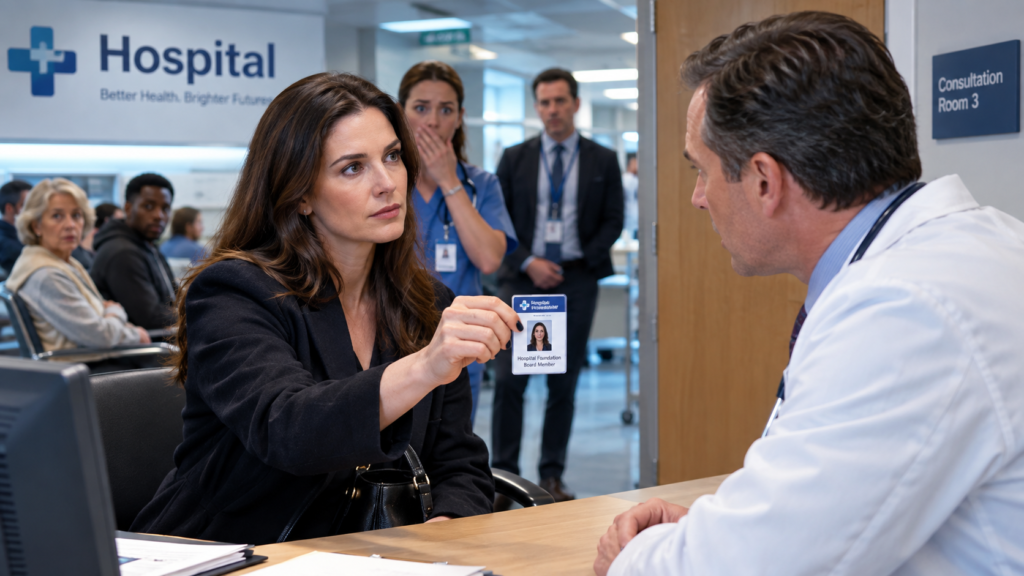
Among the patients was a woman named Claire Morgan.
She looked like an ordinary patient.
She wore a simple dark jacket, carried a small handbag, and had no visible signs that she was about to become the center of attention.
Claire had arrived at the hospital earlier that morning for a follow-up appointment.
Several days earlier, she had undergone a series of medical tests. She had been told that her report would be available during her next visit.
So she waited.
Twenty minutes passed.
Then thirty.
Finally, a doctor stepped out of one of the consultation rooms.
“Claire Morgan?”
She immediately stood up.
“Yes.”
The doctor checked the file in his hand.
“Please come with me.”
Claire followed him into the consultation room.
She sat down while the doctor remained standing near the desk.
For a moment, he looked through the paperwork without saying anything.
Then he closed the file.
“I’m afraid we won’t be able to show you the complete report today,” he said.
Claire looked surprised.
“Why not?”
“The report needs to be reviewed first.”
“But I was told it would be available today.”
“I understand,” the doctor replied. “But you’ll have to wait.”
Claire remained calm.
“I don’t want to cause any problems. I simply want to understand what my test results say.”
The doctor sighed.
“We’ll contact you when everything is ready.”
Claire stared at him for a few seconds.
There was something strange about the way he was avoiding the subject.
She had expected a normal medical discussion.
Instead, she was being asked to leave without even seeing the information she had come to receive.
“Doctor,” she said quietly, “is there something wrong with the report?”
The doctor didn’t answer immediately.
That silence made Claire even more suspicious.
“I think it would be better if you waited for the official review,” he finally said.
Claire slowly stood up.
“Okay.”
She picked up her handbag.
But before leaving the room, she turned around.
“May I ask you one question?”
The doctor nodded.
“Why are you treating me differently?”
The doctor looked confused.
“I’m not treating you differently.”
Claire gave him a faint smile.
“I think you are.”
She walked toward the door.
Then she stopped.
She reached into her handbag.
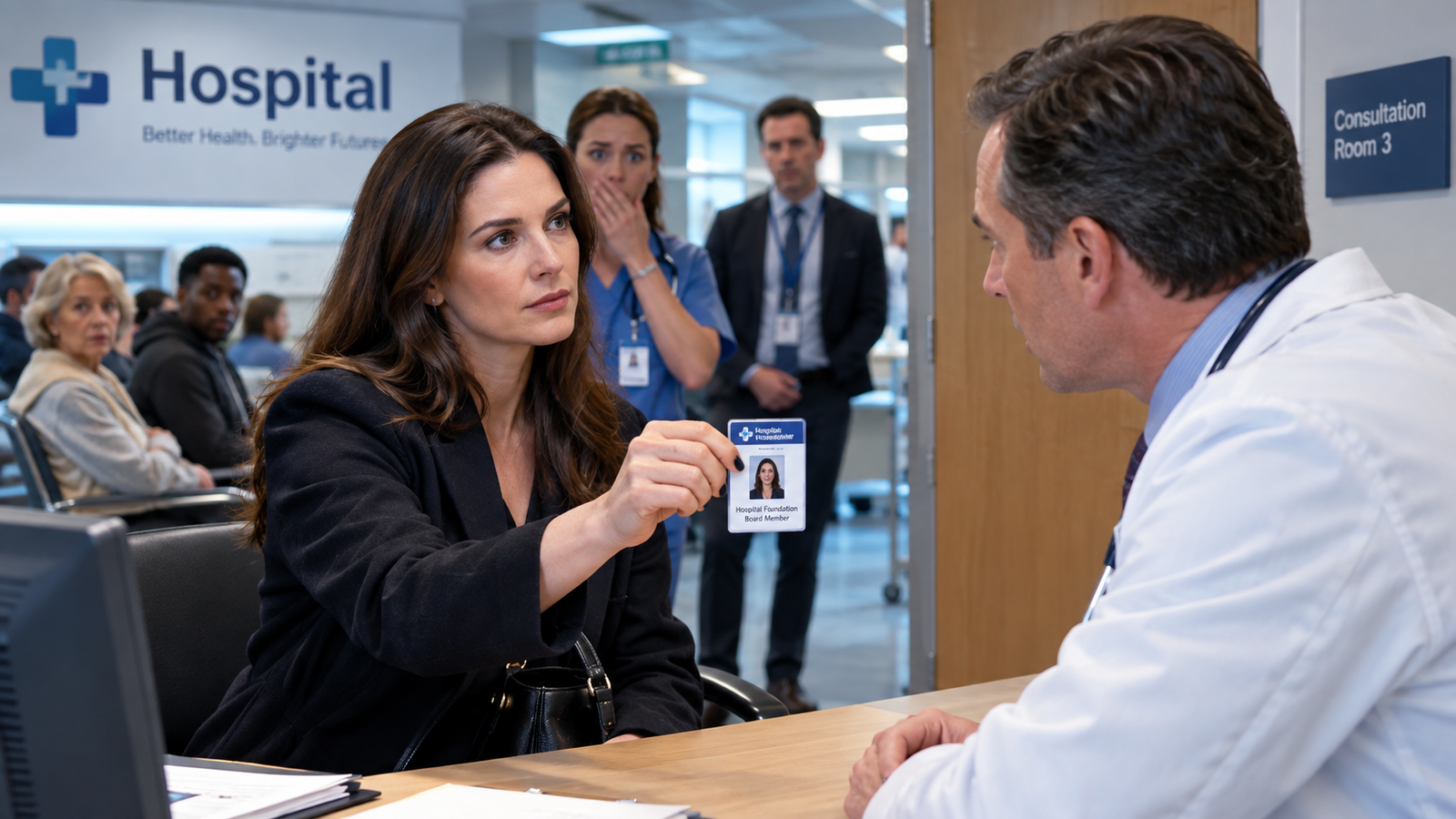
The doctor watched as she pulled out a small identification card.
She placed it on the desk.
“You should probably know who you’re talking to before you make that decision.”
The doctor glanced at the card.
At first, there was no reaction.
Then he looked again.
His expression changed.
Claire noticed.
“You recognize it?”
The doctor slowly picked up the card.
“Yes.”
His voice had suddenly become quieter.
Claire didn’t say anything.
The doctor looked back at her.
“Why didn’t you tell us who you were when you arrived?”
“Because I didn’t want anyone to treat me differently.”
The doctor remained silent.
Claire had intentionally arrived without announcing her connection to the hospital.
She wanted to be treated like any other patient.
She wanted to see how the system worked when nobody knew her name or position.
But what the doctor didn’t know was that Claire had a much deeper connection to the hospital than anyone in that waiting room could have imagined.
She wasn’t simply a patient.
She was one of the people responsible for the hospital’s future.
Years earlier, Claire’s family had helped establish a foundation that provided major financial support to the medical center.
But Claire had never wanted special treatment because of it.
In fact, she had specifically requested that her identity remain private during her appointment.
The doctor slowly sat down.
“So you’re…”
Claire nodded.
“Yes.”
Outside the room, a nurse noticed that something unusual was happening.
The doctor wasn’t speaking.
Claire wasn’t angry.
But the atmosphere had completely changed.
The nurse knocked on the door.
“Doctor, is everything okay?”
The doctor looked at Claire.
She nodded.
“Let her come in.”
The nurse entered.
She looked at the doctor, then at Claire.
“What happened?”
The doctor handed the identification card to the nurse.
The nurse looked at it.
Her eyes widened.
“Oh.”
Claire smiled politely.
“Please don’t.”
The nurse immediately understood.
Claire wasn’t interested in being treated like an important person.
“I came here because I’m a patient,” Claire explained. “That’s all.”
The doctor looked embarrassed.
“I didn’t know.”
“That’s exactly why I didn’t tell anyone.”
Claire sat down again.
“I wanted to know whether someone without influence could ask a simple question and receive a simple answer.”
The room became silent.
The doctor’s expression changed from embarrassment to concern.
“I understand what you’re saying.”
Claire nodded.
“But there’s something else.”
She pointed toward the medical file.
“I still want to know why my report wasn’t shown to me.”
The doctor opened the file again.
This time, he carefully reviewed every page.
After several seconds, he explained that the report required additional review because one of the results needed clarification before being discussed.
Claire listened carefully.
“So there wasn’t an emergency?”
“No,” the doctor replied. “But we wanted the physician responsible for your case to review it first.”
Claire nodded.
“That makes more sense.”
The tension in the room began to disappear.
But Claire wasn’t finished.
She asked the doctor another question.
“If I hadn’t shown you that identification card, would you have explained that to me?”
The doctor paused.
That was the question nobody wanted to answer.
Finally, he said:
“I should have.”
Claire nodded.
“That’s all I wanted to hear.”
The nurse looked at Claire.
“Are you going to report him?”
Claire smiled.
“I didn’t come here to punish anyone.”
She picked up the report.
“I came here to understand something.”
“What?”
“How people are treated when they don’t have a powerful name behind them.”
The nurse looked down.
The doctor appeared thoughtful.
Claire continued.
“A hospital should make patients feel safe enough to ask questions. They shouldn’t have to prove that they’re important before someone listens.”
Her words changed the atmosphere completely.
The doctor apologized.
Not because Claire had influence.
But because he realized that he had failed to communicate properly.
“I should have explained the situation from the beginning,” he said.
Claire nodded.
“Yes.”
She stood up.
“Then let’s make sure the next patient gets that explanation.”
The doctor looked at her.
“What do you mean?”
Claire revealed that she planned to meet with hospital administrators later that day.
She wanted to discuss how patients were informed about reports, delays, and follow-up procedures.
She wasn’t demanding special privileges.
She was asking for better communication.
The story quickly spread through the hospital.
Employees who had initially been shocked by Claire’s identity began talking about the lesson behind the encounter.
One nurse later admitted that she had assumed Claire was simply another patient waiting for an appointment.
“That was the point,” Claire reportedly told her.
“I wanted to be another patient.”
By the afternoon, Claire was sitting in a meeting with several hospital administrators.
She explained what had happened from beginning to end.
Nobody was fired.
Nobody was publicly humiliated.
Instead, the hospital leadership agreed to review its communication procedures.
Patients would receive clearer explanations when reports required additional review.
Staff members would be encouraged to explain delays instead of simply telling patients to wait.
Claire listened as the administrators discussed the changes.
Then she said something that surprised everyone in the room.
“Don’t do this because you know who I am.”
The room became quiet.
“Do it because you don’t know who the next patient is.”
That sentence stayed with everyone.
Because Claire’s real lesson had nothing to do with her identity.
It was about how easily people can make assumptions based on appearance, status, clothing, or influence.
A person sitting quietly in a hospital waiting room might be a teacher.
A factory worker.
A business owner.
A parent.
A millionaire.
Or simply someone who is scared and needs an answer.
The right treatment shouldn’t depend on any of those things.
Before leaving the hospital that evening, Claire stopped near the same waiting room where she had spent the morning.
The chairs were still full.
Patients were still waiting.
Nurses were still moving quickly.
Everything looked almost exactly the same.
But Claire knew something had changed.
She had entered the building wanting to understand her medical report.
She left knowing something much bigger.
She had learned that sometimes the most powerful lesson isn’t about who someone really is.
It’s about how we treat them before we know.
And perhaps that was the biggest surprise of the entire day.
Claire hadn’t walked into the hospital to prove that she was important.
She had walked in to see whether anyone would treat her as important without knowing her name.
In the end, her secret identity wasn’t what shocked the hospital most.
It was the realization that every patient deserves respect before they have to prove they deserve it.
Fictional story created for entertainment purposes; it does not describe a verified real-world hospital incident.