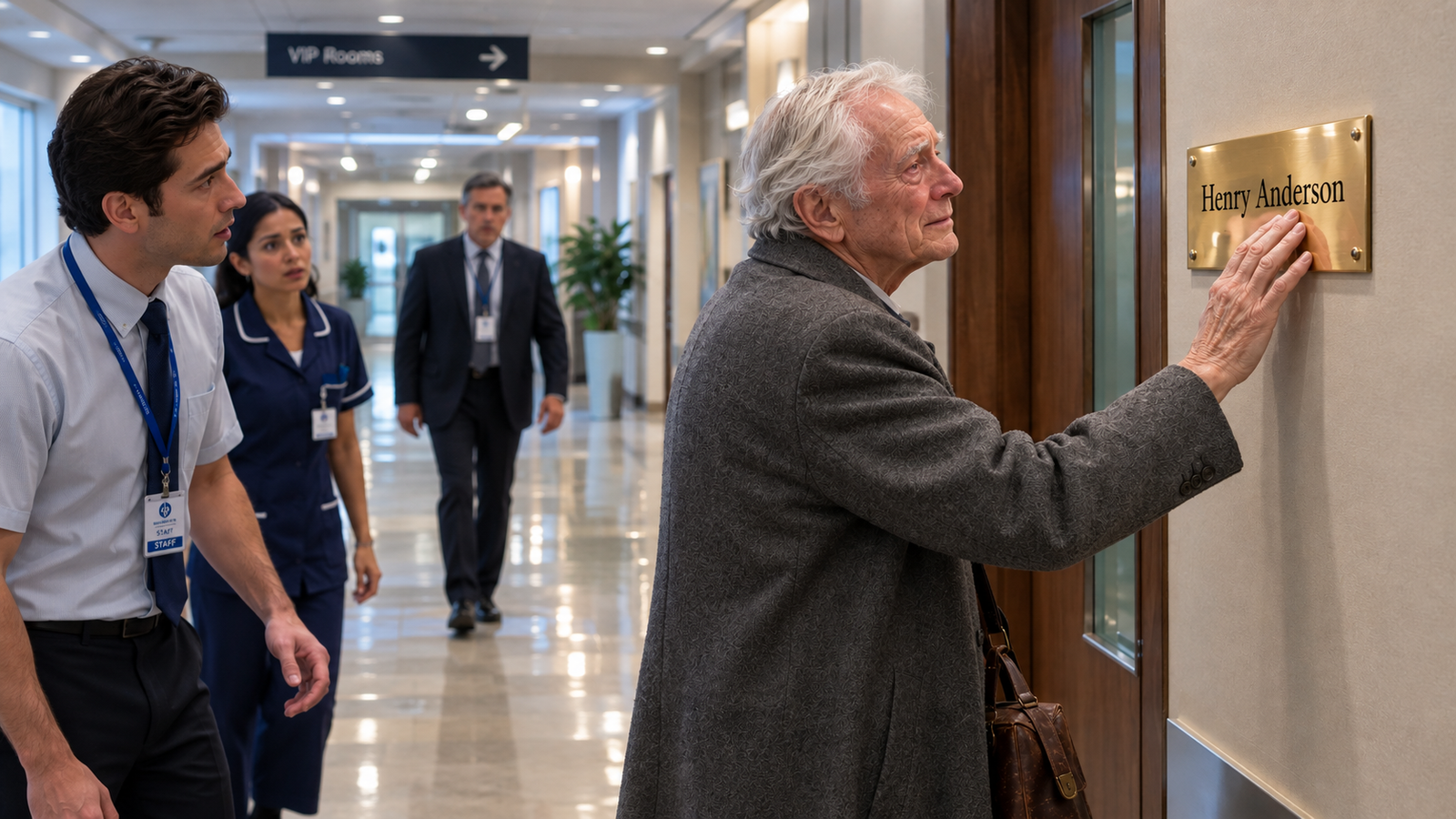
The hospital lobby was almost empty that evening.
A few patients sat quietly in the waiting area. Nurses moved quickly between departments, doctors spoke softly near the elevators, and the sound of medical equipment echoed through the long corridors.
Then the automatic doors opened.
An elderly man walked inside.
He appeared to be in his late seventies. He wore a simple gray coat, worn brown shoes, and carried an old leather bag in one hand.
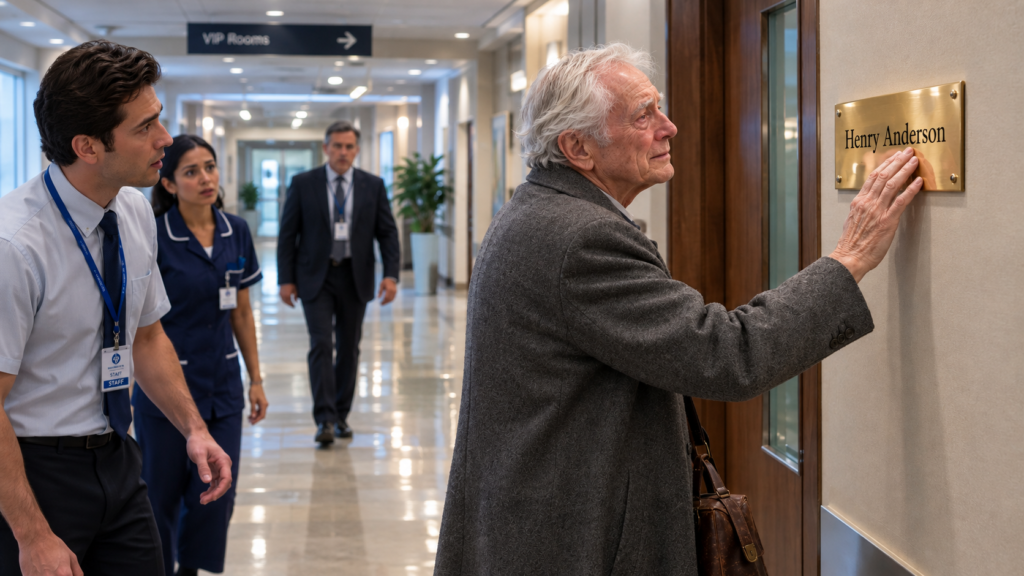
There was nothing about his appearance that suggested wealth or importance.
He didn’t have an assistant.
He didn’t have a driver waiting outside.
He didn’t even have someone accompanying him.
He simply walked through the hospital entrance and looked around as if he already knew exactly where he was going.
After a few seconds, he headed toward a private hallway.
The hallway led to the hospital’s VIP rooms.
A young hospital staff member noticed him approaching.
“Sir,” the employee called out, walking toward him. “Can I help you?”
The old man stopped.
“I need to go to one of the rooms down there.”
The staff member looked toward the VIP hallway and then back at the elderly man.
“I’m sorry, sir, but this area is restricted.”
The old man remained calm.
“I understand.”
“Only authorized visitors, doctors, and patients are allowed beyond this point.”
“I only need a few minutes.”
The employee shook his head.
“I’m really sorry. Hospital policy.”
The old man looked down the hallway.
At the very end stood a large private room with a polished wooden door.
He stared at it for several seconds.
“I’ve been away for a long time,” he said quietly.
The staff member didn’t understand what he meant.
“Sir, if you’re looking for a patient, I can check the system for you.”
The old man slowly shook his head.
“No. I know exactly where I’m going.”
He took another step.
The employee gently stopped him.
“You really can’t enter this section without authorization.”
The old man looked at the employee.
There was no anger in his eyes.
Only sadness.
“Then I’ll wait here.”
He moved to a nearby chair and sat down.
For several minutes, he simply watched the hallway.
The staff member returned to the reception desk.
He assumed the elderly man would eventually leave.
But the man didn’t.
After a while, he stood up again.
He walked slowly toward the restricted hallway.
The staff member noticed him and approached once more.
“Sir, I already explained—”
The old man suddenly stopped.
His eyes were fixed on something beside the VIP room.
A polished metal nameplate was mounted on the wall.
The staff member followed his gaze.
Then he noticed the elderly man’s expression.
The man’s face had completely changed.
His eyes became wet.
His lips trembled slightly.
He took a step closer to the door.
The staff member looked at the nameplate.
Then he looked at the old man.
“Sir…”
The old man didn’t answer.
He reached out and gently touched the nameplate.
His fingers moved across the engraved letters.
The name on the plate belonged to him.
Henry Anderson.
The staff member stared at him.
“Is… that your name?”
The elderly man nodded.
“Yes.”
The employee looked confused.
“Do you know why your name is on this room?”
Henry looked through the glass panel beside the door.
“I know.”
His voice was barely audible.
“This was never supposed to be a VIP room.”
The staff member didn’t know what to say.
Just then, another nurse walked over.
“What happened?”
The employee pointed toward the nameplate.
The nurse looked at it and then at Henry.
She didn’t recognize him.
“Sir, are you a relative of Mr. Anderson?”
Henry smiled sadly.
“No.”
He paused.
“I am Henry Anderson.”
The nurse froze.
Before anyone could respond, footsteps suddenly echoed from the other side of the hallway.
The hospital administrator was walking quickly toward them.
He had been called by a member of the staff.
But the moment he saw Henry, he stopped.
His expression changed completely.
“Mr. Anderson?”
Henry turned.
The administrator stared at him for several seconds.
Then he walked forward.
“I can’t believe you’re here.”
Henry gave him a small smile.
“I wanted to see the room.”
The administrator’s eyes filled with emotion.
“You should have called us.”
Henry shook his head.
“If I had called, everyone would have prepared.”
The administrator understood exactly what he meant.
Henry had never liked special treatment.
He had spent most of his life avoiding attention.
The staff members standing nearby were now completely confused.
The administrator finally turned toward them.
“Everyone, this is Mr. Henry Anderson.”
He paused.
“He founded this hospital.”
Silence filled the hallway.
The young employee who had stopped Henry earlier looked shocked.
“This hospital?”
The administrator nodded.
“Not just this hospital. Mr. Anderson funded the original medical center more than thirty years ago.”
Henry looked uncomfortable.
“You don’t need to explain all that.”
But the administrator continued.
“He donated most of his personal fortune to build this place.”
The staff looked at the old man’s simple coat and worn shoes.
Suddenly, his appearance seemed completely different.
Not because he had changed.
But because they finally understood who he was.
Years earlier, Henry had been a successful businessman.
He had owned several businesses and could have lived an extremely comfortable life.
But everything changed when his wife became seriously ill.
At the time, the town had only a small medical facility.
It didn’t have enough equipment.
It didn’t have enough specialists.
And it couldn’t provide the treatment she needed.
Henry spent weeks trying to find another hospital.
By the time he finally found one, it was too late.
His wife died.
Henry never forgot the experience.
He remembered sitting beside her hospital bed and realizing that money couldn’t bring her back.
But he also remembered something else.
There were other families in that hospital who couldn’t afford even basic treatment.
Some parents were forced to choose between medical care and food.
Some elderly patients delayed treatment because they were afraid of the bills.
Henry decided that he would do something about it.
He sold part of his business empire.
Then he invested millions into building a modern hospital in his hometown.
His only condition was simple:
“No patient should be turned away simply because they cannot afford treatment.”
The hospital grew.
More doctors joined.
More departments opened.
And thousands of people received care.
But Henry remained mostly behind the scenes.
He never wanted his name displayed everywhere.
He didn’t want politicians standing beside him for photographs.
He didn’t want newspaper headlines.
He simply wanted the hospital to work.
Years passed.
Eventually, the hospital expanded and became one of the most respected medical centers in the region.
The VIP wing was added later.
But Henry had insisted that one room carry his name.
Not because he wanted luxury.
The room had originally been designed as a private recovery room for patients who needed long-term care but had no family support.
The administrator explained everything to the staff.
“That room was named after him because of what he did for this hospital.”
Henry looked at the door.
“I never asked for my name to be put there.”
The administrator smiled.
“We know.”
“Then why is it still there?”
“Because the board believed future generations should know where this place came from.”
Henry remained silent.
He looked through the glass.
The room was empty.
Clean.
Quiet.
Perfectly prepared.
After a few moments, Henry opened the door.
He slowly walked inside.
The staff watched from the hallway.
Henry placed his old leather bag on a chair.
Then he sat beside the window.
For the first time since he entered the hospital, he looked peaceful.
The administrator entered behind him.
“You’ve changed a lot,” Henry said.
“So has the hospital.”
Henry smiled.
“That’s a good thing.”
The administrator sat nearby.
“Why did you come back now?”
Henry looked outside.
“I wanted to see if it was still helping people.”
The administrator didn’t hesitate.
“It is.”
Henry nodded.
“Then I can leave peacefully.”
The administrator immediately understood the deeper meaning behind those words.
“Are you okay?”
Henry smiled.
“I’m old. That’s all.”
They sat in silence.
After several minutes, Henry stood.
Before leaving, he looked once more at the room.
Then he turned toward the administrator.
“Take good care of this place.”
“We will.”
“And remember why it was built.”
The administrator nodded.
“We won’t forget.”
Henry walked back through the hallway.
The same employee who had stopped him earlier stood near the entrance.
The employee looked embarrassed.
“Sir, I’m sorry. I didn’t know who you were.”
Henry smiled.
“You were doing your job.”
“But I treated you like you didn’t belong here.”
Henry paused.
Then he placed a hand gently on the employee’s shoulder.
“Never judge whether someone belongs somewhere by the clothes they’re wearing.”
The employee nodded.
Henry continued toward the exit.
Before he disappeared through the automatic doors, he turned around one last time.
The hospital was still busy.
Doctors were treating patients.
Nurses were helping families.
Someone was being rushed into the emergency department.
Life was continuing.
Exactly as he had hoped it would.
The employee stood quietly in the lobby watching him leave.
That evening, something changed in the way the staff looked at every person who entered the hospital.
They realized that wealth isn’t always visible.
Importance doesn’t always arrive in a luxury car.
And the person wearing the simplest clothes may sometimes be carrying the greatest story.
The old man’s name on the VIP room door had been there for years.
But that evening, the staff finally understood what the name really meant.
It wasn’t a symbol of status.
It was a reminder.
A reminder that one person’s loss can become another person’s hope.
A reminder that kindness can outlive the person who started it.
And most importantly, a reminder that you should never decide someone’s worth based on what they look like.
Henry Anderson had entered the hospital looking like an ordinary elderly man.
He left knowing that the dream he had started decades earlier was still alive.
Thousands of people had walked through those hospital doors.
Some came frightened.
Some came desperate.
Some came without enough money.
But they were treated.
They were heard.
And they were given a chance.
That was the legacy Henry wanted.
Not a luxurious room.
Not a nameplate.
Not recognition.
Just a place where someone in need could walk through the doors and hear four simple words:
“We will help you.”
And perhaps that was the real reason his name belonged on that door.