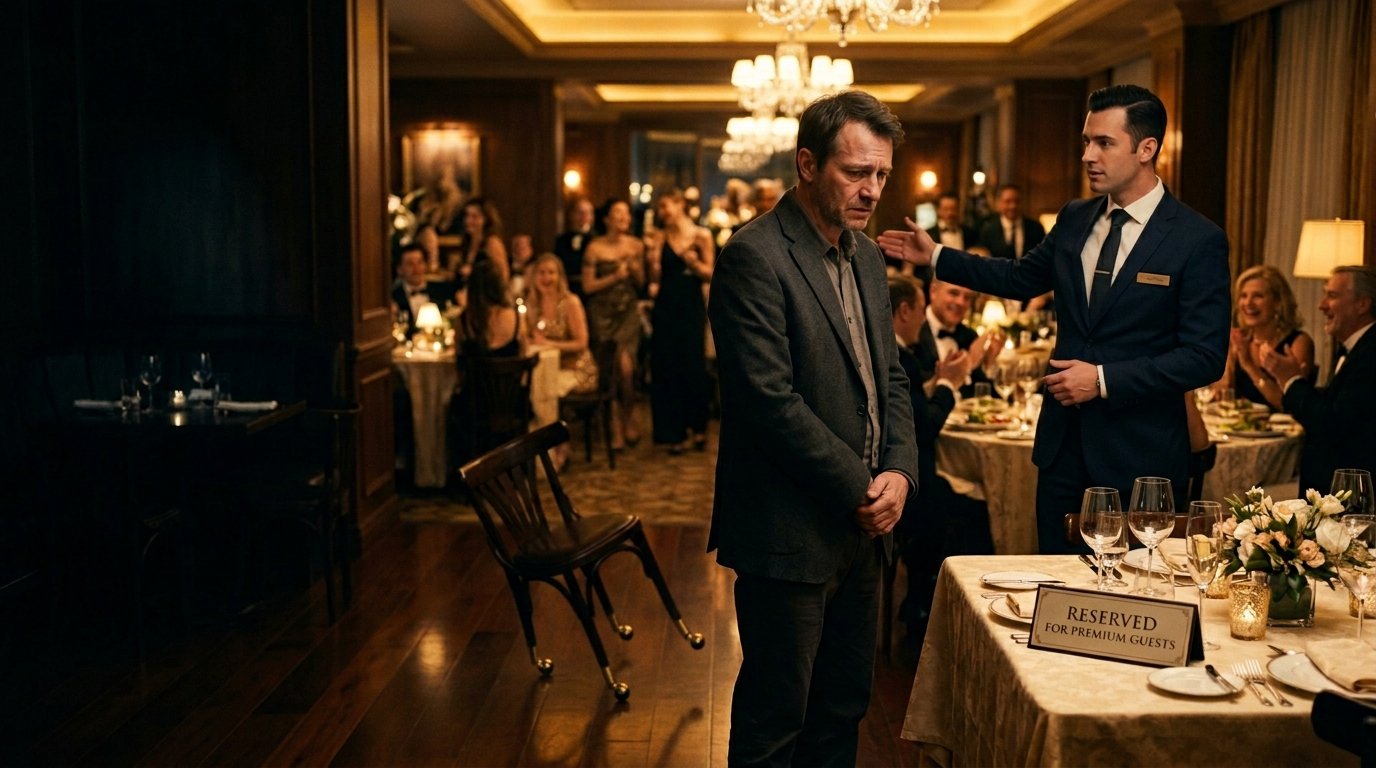
The restaurant shimmered under soft golden lights, its polished floors reflecting a world that seemed perfect from the outside. Crystal glasses chimed gently as they met in celebration, and laughter floated effortlessly through the air like it belonged there. Every table told a story of comfort, wealth, and belonging. Every corner whispered luxury.
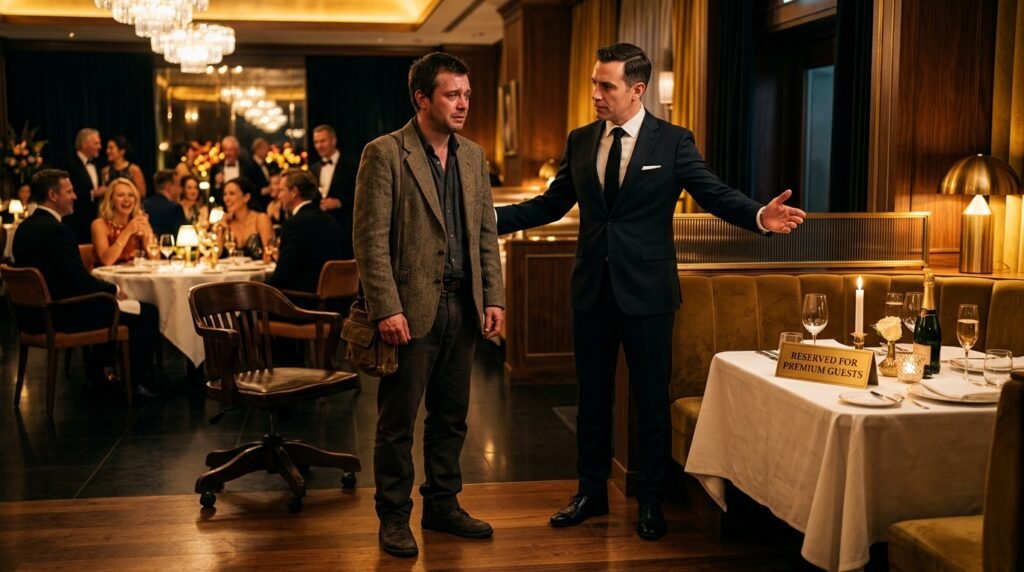
But not every story in that room was the same.
Near the entrance, a man stood quietly, almost blending into the background. His clothes were simple—neatly worn, but not new. His shoes carried the dust of long roads, and his eyes… his eyes carried something heavier than anything visible. They held hope. Fragile, trembling hope.
He looked around, taking in the beauty of the place. It wasn’t just admiration—it was longing. Not for the food, not even for the luxury, but for something deeper… acceptance.
For a moment, he gathered the courage to step forward.
His eyes landed on a table in the center of the room. It was beautifully set—fresh flowers, glowing candles, spotless plates arranged with perfection. A small sign rested on it: Reserved. But to him, it wasn’t just a table. It was a chance. A silent invitation to feel equal, just for one evening.
He walked toward it slowly, his heartbeat echoing louder than the surrounding noise. Every step carried a quiet question: “Do I belong here?”
Before he could reach the chair, a voice interrupted him.
“Excuse me, sir.”
The man turned. The manager stood there—well-dressed, confident, composed. His smile was polite, practiced, but distant.
“That table is reserved for high-spending customers,” he said gently, yet firmly.
The words were simple. There was no insult in tone, no raised voice, no harsh expression. Yet, they struck deeper than any shout ever could.
For a brief second, the man’s eyes flickered—not with anger, but with realization. It wasn’t the first time. Maybe that’s why he didn’t argue. Maybe that’s why he didn’t ask questions.
He simply nodded.
“Of course,” he whispered, forcing a small smile that didn’t quite reach his eyes.
And just like that, hope stepped aside… quietly, without making a scene.
The manager gestured toward the back. “You can sit there,” he said, pointing to a small table tucked away in a dim corner. It was clean, but invisible. A place not meant to be noticed. A place where people sat when they didn’t quite belong in the main picture.
The man walked toward it.
Each step felt heavier than the last—not because of distance, but because of what it meant. Around him, conversations continued, laughter grew louder, and glasses clinked again. Life moved on, unaffected by his small moment of rejection.
To everyone else, it was nothing.
To him, it was everything.
As he reached the corner table, he paused for a second and glanced back. The reserved table still stood there, untouched, glowing under the lights like it was waiting for someone worthy.
Not him.
He sat down slowly, placing his hands on the table as if grounding himself. His fingers traced the edge absentmindedly, as though searching for something he had lost long ago.
Maybe dignity.
Maybe belonging.
Maybe both.
At that exact moment, a strange sound broke through the air.
A chair nearby rolled slightly on its own, its wheels scraping softly against the polished floor. It wasn’t loud, but it was enough to catch attention.
One of the staff members chuckled lightly. “These old chairs need replacing,” he muttered.
Another responded casually, “Yeah, management should really upgrade things around here.”
The conversation was small, almost meaningless. Yet somehow, it echoed deeper than it should have.
Because sometimes, it’s not just furniture that gets replaced.
Sometimes, it’s people.
The man looked at the chair for a moment. Then he looked at himself.
And in that silent exchange, something unspoken passed through his mind.
Was he also something the world considered replaceable?
A presence that didn’t matter unless it brought value measured in money?
The waiter approached him, placing a menu on the table. “What would you like to order?” he asked, his tone neutral, almost mechanical.
The man opened the menu, but his eyes didn’t focus on the words. Prices stood out more than dishes. Numbers, expectations, judgments.
He closed it gently.
“Just some water,” he said.
The waiter nodded and left.
Water.
The simplest thing on the menu. The safest choice. The one that wouldn’t raise eyebrows or questions.
As the man sat there, sipping slowly, his gaze drifted across the room again. Couples laughed freely. Friends leaned in close, sharing secrets and stories. Families celebrated milestones, capturing moments that would become memories.
And there he was… sitting in the corner, watching life happen from a distance.
Not part of it.
Just witnessing it.
But what no one in that room knew—what no one even thought to ask—was his story.
They didn’t know how hard he had worked to reach this point. They didn’t see the sacrifices behind his quiet demeanor. They didn’t understand the battles he had fought silently, without applause, without recognition.
To them, he was just another customer.
But to himself… he was someone who had come a long way.
Yet somehow, in that moment, none of it seemed to matter.
Because the world didn’t measure journeys.
It measured status.
Time passed slowly. The reserved table was eventually filled—loud voices, expensive clothes, confident laughter. The kind of presence that naturally commanded attention.
The man watched them for a second.
Then he looked away.
Not out of jealousy.
But out of understanding.
He understood now.
It was never about the table.
It was about what the table represented.
Value.
Respect.
Recognition.
And in that space, those things came with conditions.
As he finished his glass of water, he stood up quietly. No one noticed. No one stopped him. No one asked if he was leaving.
Because in a place where presence is tied to spending, silence is easy to ignore.
He walked toward the exit, his steps calm, composed—just as they had been when he entered.
But something had changed.
Not in the restaurant.
Not in the people.
But within him.
Just before stepping out, he paused near the entrance and took one last look inside.
The lights still glowed.
The laughter still echoed.
The world still moved the same way.
But now, he saw it differently.
He realized something important—something deeper than rejection.
His worth was never meant to be defined by a table.
Or a price tag.
Or someone else’s approval.
Because respect isn’t something that should be reserved.
It’s something that should be given.
Freely.
Equally.
Without conditions.
And as he walked away into the night, the city lights reflecting softly in his eyes, there was no anger… no bitterness.
Just a quiet strength.
Because sometimes, the deepest dignity is found not in where you are allowed to sit…
But in knowing when to stand up and walk away.