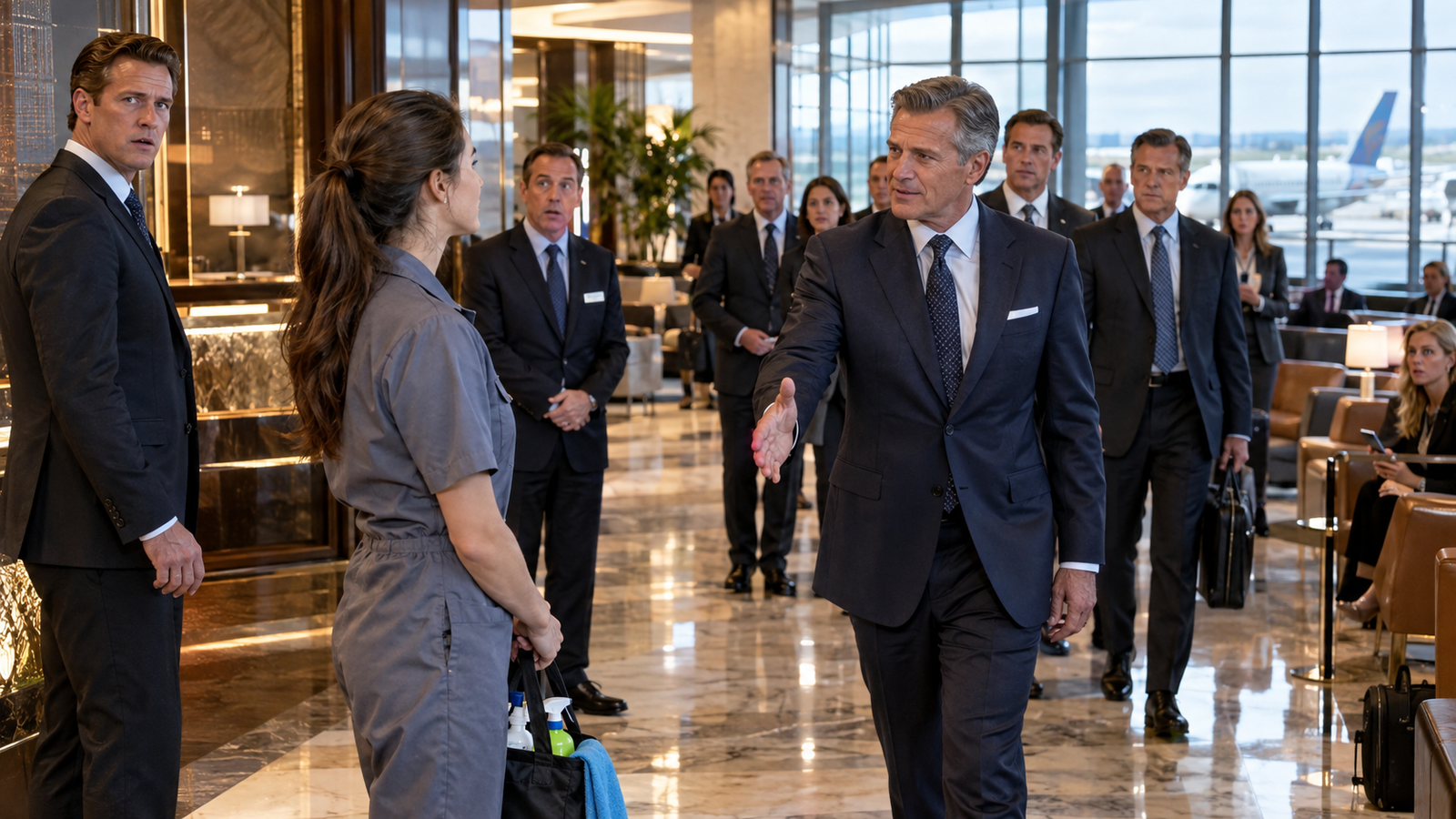
The VIP airport lounge was designed for people accustomed to being treated differently.
Located inside one of New York’s busiest international terminals, the private lounge offered luxury seating, quiet meeting rooms, private dining, showers, and direct access to premium airport services.
Executives regularly held meetings there.
Celebrities waited there between flights.
International investors used the private conference rooms.
Entry was carefully controlled.
Only selected passengers, executives, and authorized guests were allowed inside.
On a busy afternoon, a young woman approached the private entrance.
Her name was Sophia Reed.
She was 29 years old.
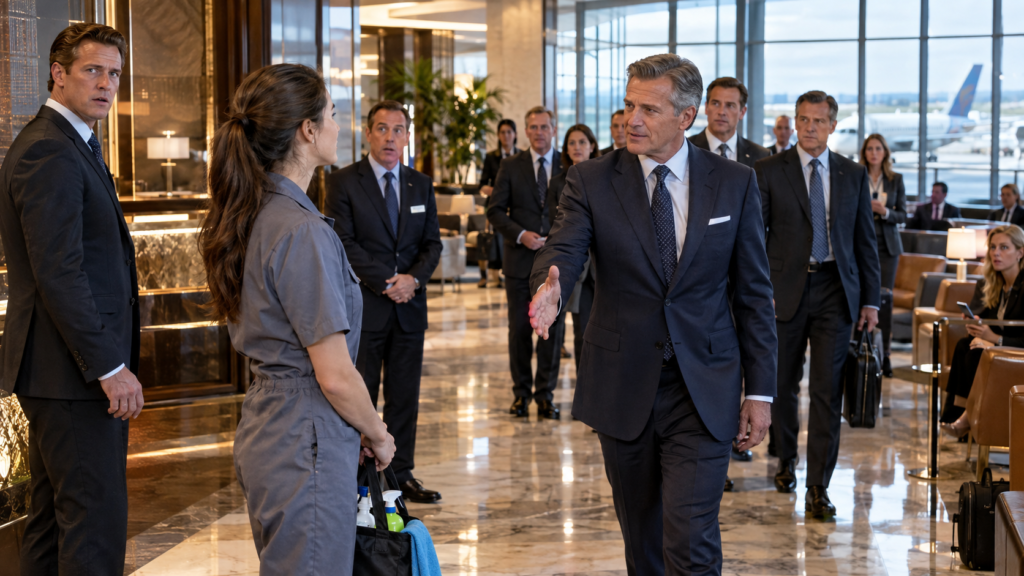
She had long dark hair, a calm expression, and a simple maintenance uniform.
In one hand, she carried a small cleaning bag.
She looked exactly like someone who worked behind the scenes at the airport.
Nobody would have guessed that she was one of the most influential people connected to the airline operating the terminal.
Sophia walked toward the VIP entrance.
A lounge manager immediately noticed her.
He stepped forward.
“Excuse me.”
Sophia stopped.
“Can I help you?” she asked.
The manager looked at her uniform.
“Employees aren’t allowed through this entrance.”
Sophia remained calm.
“I need to go inside.”
The manager shook his head.
“This entrance is for VIP passengers and authorized executives.”
Sophia looked at the doorway.
“I understand.”
The manager pointed toward the other side of the terminal.
“Staff entrance is over there.”
Sophia didn’t move.
“I need to attend a meeting.”
The manager looked confused.
“A meeting?”
“Yes.”
He glanced at her uniform again.
“With whom?”
Sophia smiled politely.
“I’ll let them know I’m here.”
The manager became increasingly suspicious.
He had dealt with airport staff for years.
He knew that employees sometimes attempted to use restricted areas.
He assumed Sophia was simply another worker who didn’t understand the rules.
“You can’t enter this lounge without authorization.”
Sophia nodded.
“That’s okay.”
Then she reached into her pocket.
She pulled out her phone.
The manager watched closely.
Sophia made one short call.
She didn’t explain anything.
She didn’t raise her voice.
She simply said:
“I’m at the entrance.”
Then she ended the call.
The manager smiled.
“Who did you call?”
Sophia looked at him.
“Someone who can help.”
He laughed quietly.
“Okay.”
He assumed she had called a supervisor.
He had no idea.
Sophia stepped away from the entrance.
She waited.
Thirty seconds passed.
Then something unexpected happened.
The private lounge doors opened.
Several senior airline executives walked out.
The manager immediately recognized them.
His expression changed.
Behind them came an older man wearing an elegant dark suit.
It was Robert Mitchell, the chairman of the airline.
The manager straightened immediately.
“Mr. Mitchell.”
The chairman didn’t stop.
He looked around.
Then his eyes found Sophia.
His face immediately softened.
“Ms. Reed.”
Sophia smiled.
“Hello, Robert.”
The chairman walked directly toward her.
He extended his hand.
“Welcome back.”
The manager stared.
Robert continued.
“We’ve been waiting for you.”
Sophia nodded.
“Sorry I’m late.”
“You’re right on time.”
The manager looked between them.
He couldn’t understand.
The chairman turned toward the executives.
“Let’s begin.”
Then he looked at Sophia.
“Would you like to use the private conference room?”
Sophia nodded.
“Yes.”
They began walking toward the lounge.
The manager stood frozen.
Finally, he spoke.
“Mr. Mitchell?”
The chairman stopped.
The manager pointed toward Sophia.
“I thought she was airport maintenance.”
Robert looked at him.
“She is.”
The manager appeared confused.
Robert continued.
“She is also our largest shareholder.”
The manager’s face went blank.
Sophia was not simply an airport employee.
She was the majority shareholder behind the airline’s largest investment group.
She had been involved in the company’s expansion strategy for years.
But she had deliberately avoided public attention.
Sophia believed that business leaders sometimes became disconnected from the people who kept their organizations running.
Executives saw reports.
They saw presentations.
They saw financial statements.
But they didn’t always see what happened on the ground.
Sophia wanted to see it for herself.
That was why she occasionally visited airports without announcing her identity.
She wanted to observe.
She wanted to see how employees treated passengers.
She wanted to see how managers treated staff.
And most importantly, she wanted to know whether the company lived up to its values.
That afternoon, she had learned something important.
The manager hadn’t necessarily done anything wrong by enforcing the access rules.
He had been right to verify authorization.
The problem was how quickly he had judged her.
He had looked at her uniform and assumed she couldn’t possibly belong in the lounge.
Sophia understood the difference.
Security procedures were important.
Respect was important too.
Inside the private lounge, Sophia sat down with the chairman and several executives.
A large presentation screen displayed the company’s upcoming expansion plan.
The airline was preparing to open new international routes and upgrade several major airport facilities.
Sophia listened carefully.
She asked questions.
She reviewed financial projections.
She discussed customer experience.
Then she brought up something unexpected.
“The staff areas need improvement.”
The executives looked at each other.
Sophia continued.
“Passengers experience the airline through the employees.”
She explained that cleaning staff, baggage handlers, customer-service agents, security personnel, and flight crews all influenced how travelers viewed the company.
Luxury wasn’t just about VIP lounges.
It was about how every passenger felt from the moment they entered the airport.
The chairman agreed.
Sophia’s philosophy was simple.
If a company wanted customers to feel respected, it had to respect its employees first.
The meeting continued for several hours.
But outside the conference room, the manager who had stopped her couldn’t stop thinking about what had happened.
He had been certain that Sophia didn’t belong there.
Now he knew that she had more authority over the airline than almost anyone in the building.
He eventually approached her after the meeting.
“Ms. Reed?”
Sophia turned.
“I wanted to apologize.”
Sophia nodded.
“What for?”
“I judged you.”
Sophia looked at him.
“You were doing your job.”
“I should have been more respectful.”
Sophia smiled.
“That’s all I wanted.”
The manager looked surprised.
She didn’t demand punishment.
She didn’t ask the chairman to fire him.
She simply wanted him to understand the lesson.
Sophia then said something he would remember.
“You shouldn’t need to know who someone is before treating them well.”
The manager nodded.
That sentence stayed with him.
The incident also changed how he managed the lounge.
He continued enforcing security rules.
But he stopped making assumptions.
He learned to separate verification from judgment.
A uniform could tell him someone’s role.
It couldn’t tell him their worth.
That distinction mattered.
Sophia’s story eventually became known among senior airline employees.
Some people were amazed that the company’s largest shareholder had walked through the airport dressed like a maintenance worker.
Others admired her willingness to see the business from the perspective of ordinary employees.
But Sophia didn’t consider it unusual.
She believed leaders needed to understand the environments their employees worked in.
A boardroom could tell you what was supposed to happen.
The airport floor could tell you what actually happened.
That afternoon, Sophia had seen both.
And the experience reinforced something she had believed for years.
People should not be treated according to their perceived wealth.
They should be treated according to their humanity.
The wealthy businessman who had watched the incident from the lounge entrance later apologized as well.
He had assumed Sophia was simply an employee.
He realized that his own assumptions had been just as careless.
The situation became a quiet reminder throughout the organization.
You never really know who is standing in front of you.
The person in a maintenance uniform could be an owner.
The person carrying a toolbox could be an engineer.
The person cleaning a room could be the person responsible for the building.
The person sitting quietly in the corner could be the investor financing the entire project.
Appearance gives you information.
But it rarely gives you the whole story.
Sophia’s power didn’t come from her expensive assets or her position as a major shareholder.
Her greatest strength was that she didn’t need to display any of it.
She could walk through an airport looking completely ordinary.
She could stand in front of a VIP lounge without demanding special treatment.
And when someone judged her, she didn’t become angry.
She simply waited for the truth to reveal itself.
When the chairman arrived, she didn’t celebrate the moment.
She didn’t humiliate the manager.
She didn’t say, “You should have known who I was.”
Instead, she used the moment to teach a much more valuable lesson.
Respect shouldn’t depend on status.
If someone is wearing a maintenance uniform, treat them with respect.
If someone is wearing a business suit, treat them with respect.
If someone is traveling first class, treat them with respect.
If someone is carrying a cleaning bag, treat them with respect.
Because you don’t know their story.
You don’t know what they have achieved.
You don’t know who they are responsible for.
And you certainly don’t know what role they may play behind the scenes.
Sophia arrived at the airport looking like someone nobody would notice.
But when she entered the VIP lounge, the airline chairman personally welcomed her.
The same woman who had been redirected toward the staff entrance was now sitting in the executive conference room discussing the company’s future.
Her clothes had never changed her importance.
Only people’s perception of her had changed.
And that is the real lesson.
Never judge someone’s importance by the uniform they’re wearing.
You may be looking at an ordinary employee.
Or you may be looking at the person who owns the company.
Either way, they deserve respect.